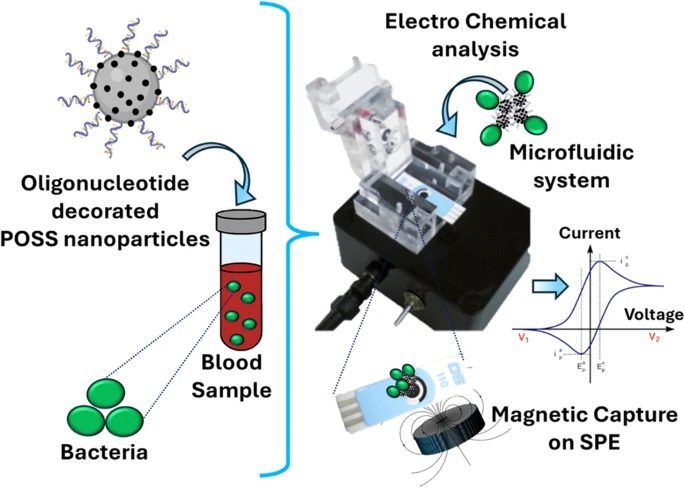
The development of sustainable and highly sensitive diagnostic platforms is critical for rapid pathogen identification and effective disease management. Here, a green, magneto-electrochemical biosensing strategy is reported for the selective detection of Streptococcus pneumoniae based on pathogen-specific nuclease activity. Uniform organic–inorganic hybrid polyhedral oligomeric silsesquioxane (POSS) nanoparticles were synthesized via an ultrafast UV-initiated emulsion polymerization within 5 min using an eco-friendly approach. The nanoparticles were sequentially functionalized by in situ deposition of superparamagnetic iron oxide nanoparticles and biomimetic polydopamine coating, enabling robust and high-density immobilization of nuclease-responsive oligonucleotide probes. The resulting PDA@SPION/POSS nanohybrids exhibit controlled size, preserved structural integrity, and strong superparamagnetic behavior, allowing efficient magnetic manipulation and electrochemical signal transduction. Upon exposure to S. pneumoniae, nuclease-mediated probe cleavage produces a pronounced electrochemical response, enabling label-free detection over a wide dynamic range (102–10⁸ CFU mL⁻¹) with a detection limit of 102 CFU mL⁻¹. High selectivity against non-target bacteria highlights the specificity of the enzymatic recognition mechanism. This work establishes a sustainable and amplification-free biosensing platform with strong potential for rapid clinical diagnostics.
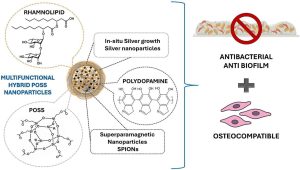
Nano-engineered materials, particularly those featuring bio-based surface modifications, are emerging as effective tools in combating bacterial infections. In this study, polyhedral oligomeric silsesquioxane (POSS) nanoparticles were functionalized with silver nanoparticles (Ag), superparamagnetic iron oxide nanoparticles (SPIONs), and the biosurfactant rhamnolipid (RL)—either individually or in combination—to evaluate their antibacterial and antibiofilm activities against Staphylococcus aureus (S. aureus) and Pseudomonas aeruginosa (P. aeruginosa). The modified nanoparticles exhibited sizes ranging from 127 to 227 nm and demonstrated superparamagnetic behavior, offering potential for magnetic targeting. Among the various formulations, the RL-coated, silver- and SPION-decorated POSS nanoparticles (RSMP) exhibited the highest antibacterial efficacy, reducing S. aureus and P. aeruginosa colony growth by approximately 90 % and 66 %, respectively, at a concentration of 0.01 g/L. RSMP nanoparticles also showed strong biofilm inhibition and had the lowest MIC₅₀ values. Notably, these nanoparticles supported the proliferation of human osteoblasts at concentrations up to 0.05 g/L, indicating favorable cytocompatibility. Overall, RSMP nanoparticles present a promising platform for magnetically targetable antibacterial agents, with potential applications in biomedical fields, particularly for managing orthopedic infections.
The integration of superparamagnetic iron oxide nanoparticles (SPIONs) into functional hybrid nanostructures remains a challenge, particularly in preserving their magnetic properties within composite frameworks. Herein, we present a rapid and environmentally friendly synthesis strategy for SPION-decorated polyhedral oligomeric silsesquioxane (POSS) nanoparticles. The process involves UV-induced polymerization to form POSS nanoparticles, followed by in situ SPION precipitation, with comprehensive characterization performed via SEM, FTIR, XRD, and VSM analyses. This approach enables the fabrication of hybrid nanoparticles (~160 nm) within 5 min and subsequent SPION decoration in under an hour, ensuring (10 emu/g) superparamagnetic behavior. The developed method is highly scalable, efficient, and compatible with green chemistry principles, making it a promising platform for engineering advanced hybrid nanostructures. These nanoparticles hold significant potential for applications in biomedicine, catalysis, and next-generation material science.
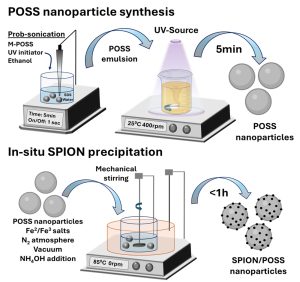
The integration of superparamagnetic iron oxide nanoparticles (SPIONs) into functional hybrid nanostructures remains a challenge, particularly in preserving their magnetic properties within composite frameworks. Herein, we present a rapid and environmentally friendly synthesis strategy for SPION-decorated polyhedral oligomeric silsesquioxane (POSS) nanoparticles. The process involves UV-induced polymerization to form POSS nanoparticles, followed by in situ SPION precipitation, with comprehensive characterization performed via SEM, FTIR, XRD, and VSM analyses. This approach enables the fabrication of hybrid nanoparticles (~160 nm) within 5 min and subsequent SPION decoration in under an hour, ensuring (10 emu/g) superparamagnetic behavior. The developed method is highly scalable, efficient, and compatible with green chemistry principles, making it a promising platform for engineering advanced hybrid nanostructures. These nanoparticles hold significant potential for applications in biomedicine, catalysis, and next-generation material science.